AI in Marketing: 7 Examples and Strategies for 2026
Seven practical examples of how AI in marketing actually works in 2026, starting with hyper-personalization and ending with the EU AI Act.
· 7 min
Today, AI is your autonomous agent. You set the goal, and the system finds the way there. What you get is a measurable gain in efficiency, which is worth a lot more than pretty text. What that means in practice is easiest to show with concrete examples rather than buzzwords.
Where AI is used in marketing
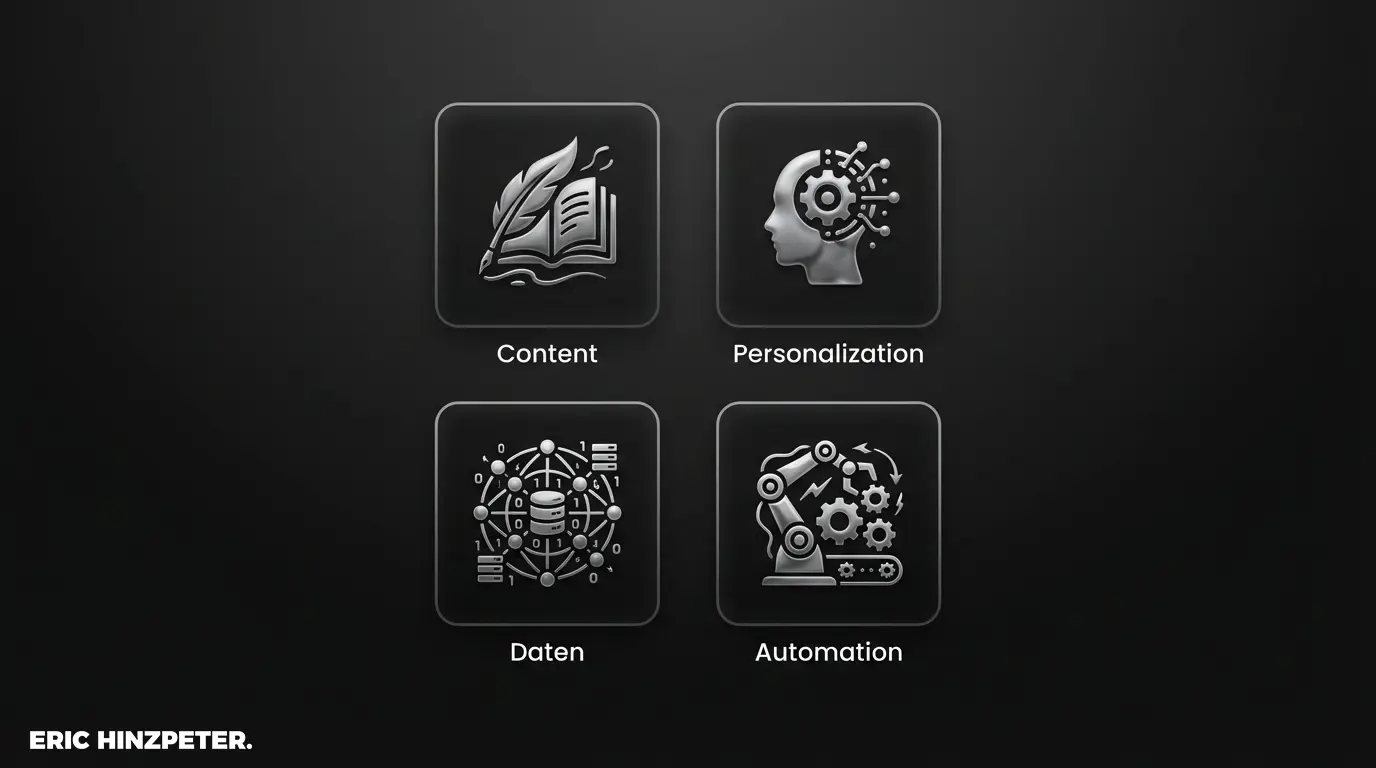
AI now runs through the whole marketing architecture instead of sitting in a few individual tools. There are four areas you should have on your radar before you roll out anything new.
Content creation and optimization is the most obvious one. It covers more than blog text: social media assets, videos and code, all of it scalable. Tools like peec.ai track your AI visibility, while ahrefs or Sistrix provide the data. Almost as important is personalization and the customer journey, the "Netflix principle": your customers expect offers based on their behavior, and the customer experience gets calculated in real time.
Then there's data analysis and forecasting, which means knowing what will happen before it happens. We use CRM data to look ahead, which is predictive analytics. And marketing automation keeps processes running around the clock, from email marketing and support to monitoring your SEO and GEO rankings.
Overall, automation means recurring processes no longer tie up people. That frees up room for real strategy work, instead of teams getting stuck in operational busywork.
You'll find more on the individual tools in my article on the top 5 AI tools in content marketing.
7 practical examples of AI in marketing (2026 edition)
Theory only gets you so far. Here are seven examples of how intelligent systems actually work today, beyond "write me a LinkedIn post".
1. Hyper-personalization (segment of one)
Forget classic audience analysis and personas like "Manfred, 50, likes reading the newspaper". We work with the segment of one: personalization is based on real-time data, not on assumptions. Amazon and Netflix have been showing how it's done for years.
In 2026, modern CRMs make this technology available to small and mid-sized businesses too. If the AI notices that a user responds to visual stimuli, it shows them more images and less text. The prerequisite is still a clean data foundation. Without one, even the best personalization is just guessing.
2. Autonomous content agents (agentic AI)
This is where the biggest shift is happening right now. You no longer chat with the bot. Instead you give the agent a goal: "Create a campaign for product X." The agent researches trends on its own, writes drafts, generates images and puts them in front of you for approval, often while you're asleep. The one that made headlines here was OpenClaw, formerly known as ClawdBot, though it also comes with real security risks.
3. Predictive analytics and churn prevention
Why wait until the customer cancels? Predictive analytics uses historical data to predict the future. The AI calculates the likelihood of churn, the churn rate, and the customer lifetime value. If the system spots that a top customer is at risk, it automatically triggers a win-back campaign, instead of someone on the sales team happening to notice.
4. Real-time video generation and avatars in sales
Personalized videos in sales don't scale? Yes, they do. This kind of scale used to be expensive. With tools like ElevenLabs for voice cloning and Higgsfield AI for video, teams can now send videos in which a photorealistic avatar addresses the customer by name, without any camera at all.
For personal avatars, tools like HeyGen or Synthesia work well. The effort per video drops from hours to minutes.
5. Programmatic advertising and smart bidding
If you set bids in performance marketing by hand, you're burning money. AI-driven programmatic advertising decides in milliseconds whether an ad slot is worth its price. The algorithms optimize for the likelihood of a conversion rather than for clicks. The result is less wasted reach and a better ROI, even if no human makes the individual bid anymore.
6. AI-assisted image editing and design
Need the product in front of a beach instead of in the studio? Nano Banana Pro, Midjourney or Photoshop's AI, Firefly, handle that with a prompt. Retouching, extending the edges of an image (outpainting) or creating variants for A/B tests happen in seconds. I took a closer look at what that means for photography itself using the 2026 Photoshop update.
Automate this and you get a whole different level of speed, especially when testing creatives, where every variant used to be produced one by one.
7. AI-assisted customer service (smart chatbots)
The days of dumb chatbots that just send you round in circles are over. Modern systems understand context: instead of only sending links to the help page, they access databases, change billing addresses or cancel orders right in the chat. That takes a huge load off support, because the simple cases never reach a human in the first place.
The best AI tools for marketers
The market is full of toys, and what you need are tools. So you don't lose track in 2026, here's my curated list for a solid architecture.
The all-rounders among the LLMs are ChatGPT from OpenAI, Google Gemini and Claude, your base for text and logic. For content and presentations, Gamma AI builds complete slide decks in seconds, while Higgsfield, Weavy.ai or Freepik Spaces create AI videos just as fast.
For video and voice, ElevenLabs is the standard for synthetic voices, Opus AI pulls short-form video out of long videos, and DaVinci Resolve and Premiere Pro keep adding AI features too. For SEO and data you still need professional SEO tools: ahrefs and Sistrix for analysis, SurferSEO for content optimization and the content briefings that still matter, plus peec.ai to make sure your AI visibility strategy actually works.
How AI changes content creation
Content creation is more than "write a prompt and hit Enter". The real change is in the workflow: generative AI takes over the grunt work, and the strategy stays with you.
A modern process looks like this: ahrefs or Sistrix supply the keywords, an agent writes the brief, the AI writes the draft, and a tool like SurferSEO checks relevance. At the end, a human decides on the tone and the strategic direction of the article. Prompt engineering and context engineering are still the lever for quality, or you hand that job to a specialized agent.
When automating with AI pays off
There's one topic we've skipped so far: automation. I'm a fan of automating only once a proof of concept is in place, not before.
Do the processes hold up? Scalable? Do they already give your audience real value? Then it's time to think about automation.
For me, there's currently no better tool than n8n. It's user-friendly because it's low-code, and at the same time it offers so many ways to customize it that there are hardly any limits. The learning curve is steep, but sweet.
What the EU AI Act asks of marketers
If you use AI, you have to know the rules. The core provisions of the EU AI Act have applied since August 2, 2026. For marketers, that mainly means transparency. AI-generated content that could be mistaken for real has to be labeled in many cases.
Then there are risks around data protection and copyright. If you dump customer data into a public LLM, you have a compliance problem. Use enterprise versions that don't use your data for training. Ignorance isn't a business model here.
For more detail on the legal framework, see the practical EU overview of Article 50.
Where AI in marketing is heading in 2026
So where is this going? We're heading toward machine-to-machine marketing: your AI sales agent negotiates with your customer's AI purchasing agent, and human involvement shrinks to strategy and ethical oversight. In January, Google showed with its Universal Commerce Protocol what AI shopping systems like that can look like.
Vibe coding is getting interesting too: marketers build their own small apps and workflows simply by describing to the AI what they need, without any programming skills.
FAQ
- How is AI used in marketing in 2026?
- Beyond just writing text, AI now takes over whole processes: hyper-personalization, autonomous content agents, predictive analytics against customer churn, personalized sales videos, programmatic advertising, AI image editing and context-aware customer service. The strategy stays with people, and AI takes over the repetitive work.
- Is AI-generated marketing content allowed in the EU?
- Yes, but the core provisions of the EU AI Act have applied since August 2, 2026, with a focus on transparency. AI-generated content that could be mistaken for real often has to be labeled, and customer data only belongs in enterprise versions of LLMs that don't train on your data.
- Which AI tools do marketers actually need?
- As a base, the LLM all-rounders ChatGPT, Google Gemini and Claude for text and logic. On top of that, Gamma AI for slide decks, ElevenLabs for voices, HeyGen or Synthesia for avatars, ahrefs or Sistrix for SEO data and n8n for low-code automation.

Eric Hinzpeter
Eric Hinzpeter, Senior B2B Content Strategist. He builds AI agents and marketing automation for production use and writes up what comes out of it here.