How Strategic Content Marketing Works
Without a strategy, content marketing just burns time and budget. Here's how to build a channel, step by step, that reliably brings in customers.
· 7 min
Content marketing without a plan burns time and money. If you just start writing, you produce content nobody searches for and, in the end, nobody reads. A strategy turns that into a channel that reliably attracts customers and builds trust that lasts for years.
How much that pays off is shown by the Content Marketing Institute's current B2B study. 87 percent of the marketers surveyed say content marketing helped them build brand awareness over the past year, and 74 percent report more demand and leads. Even so, only just under half of all respondents, 47 percent, have a documented strategy at all. That gap between impact and planning is exactly why I wrote this post.
| Effect | Share of B2B marketers surveyed |
|---|---|
| More brand awareness | 87 % |
| More demand and leads | 74 % |
| Documented strategy (all respondents) | 47 % |
Source: CMI, B2B Content Marketing Trends 2025
What you'll learn in this post
- Well-known success stories in content marketing
- The definition of strategic content marketing
- The four core areas of the discipline
- How to build your own content strategy
- How to support the customer journey with content
- Which metrics show success
Success stories: Dr. Oetker and Coca-Cola
Good content marketing existed long before the internet. Two examples show this especially clearly.
Dr. Oetker, the German baking brand, was printing simple recipes on its baking powder packets decades ago, so customers could use the product properly right away. In 1911 the first Dr. Oetker school cookbook followed. That wasn't crude advertising. It was real help in customers' everyday lives.

Old-school content marketing at Dr. Oetker: the first school cookbook was a huge success. By E. Henneking, Dr. Oetker Verlag KG, used as public domain, Wikipedia
The result: the brand became a fixture in many German kitchens, and the company still benefits from that today.
Coca-Cola provides a more modern example. The "Share a Coke" campaign launched in Australia in 2011: instead of the logo, every bottle carried an individual first name, and customers shared their photos on social media of their own accord. In a country of just under 23 million people at the time, Coca-Cola sold more than 250 million printed bottles and cans in Australia. The ad agency Ogilvy put more precise numbers on the effect: Coke's market share in Australia rose by 4 percent, and consumption among young adults by 7 percent.
In the US, the campaign reversed a decline in Coca-Cola consumption that had lasted more than ten years and lifted sales by more than 2 percent. "Share a Coke" now runs in over 80 countries.
Both examples show the same pattern: if you reach your audience emotionally or help them in everyday life, you get back reach and engagement that ad budget alone can hardly buy.
Definition: what is strategic content marketing?
Before we get to practice, a clear definition helps.
In strategic content marketing, you create and distribute relevant, valuable content for a clearly defined audience. Your goal: win attention, build trust and, over the long run, move people to an action that pays off for your business.
The biggest difference from classic advertising: you don't put your product at the center, you solve a problem for your audience. This customer-centered communication lets pure product benefits take a back seat at first. You could put it more bluntly: content marketing is almost the opposite of classic product marketing, because the value for the audience comes first and the product benefit only after that.
The four core areas of content marketing
Your work as a content marketer breaks down roughly into four areas that build on each other.
- Content creation: you produce text, video, podcasts or infographics, tailored to what your audience really needs. Quality matters more than quantity here. A single podcast episode is often enough for a blog post, slides and social cards if you repurpose it.
- Content distribution: a finished post does nothing if nobody sees it. You actively spread it through social media or email newsletters instead of waiting for it to be found.
- Measuring success: with web analytics and platform statistics you check how often users see your content and how they interact with it.
- Optimization: you adjust your content based on the data. An important lever here is search engine optimization, which gets you more organic traffic from Google over the long run. How this work can be automated is something I describe in SEO content automation with AI agents.
How to build your content strategy
Without a clear strategy, your content fizzles out unseen. A good strategy usually follows these steps.
- Define goals: what do you want to achieve, brand awareness or direct lead generation? Unlike in performance marketing, short-term revenue rarely comes first here.
- Analyze the audience: who are you actually doing this for, and which formats do your potential customers prefer? Solid market research helps more than guessing, as I describe in market research automation without AI.
- Content audit: you review your existing posts and find the gaps. If you want to go deeper, the "Content Audit" episode of the Performance Content Podcast (in German) is a good place to start.
- Plan topics: you build an editorial calendar. My advice: don't set the frequency too high at the start, start moderately and keep the rhythm up reliably.
- Produce content: you work through your plan, but stay flexible enough to react to current trends.
- Distribution: you adapt your content to the quirks of each platform. Ideally you spend time there yourself to get a feel for the community's tone.
- Check results: you keep an eye on your metrics and adjust the strategy right away when a format isn't working.
Content marketing along the customer journey
Good content meets potential customers exactly where they are and guides them through every phase of their buying decision.
The main goals: more reach, stronger engagement, a better brand image, more leads and, in the end, more revenue. The real value, though, lies in something bigger, namely a communication channel that doesn't just inform customers but turns them into loyal customers step by step.
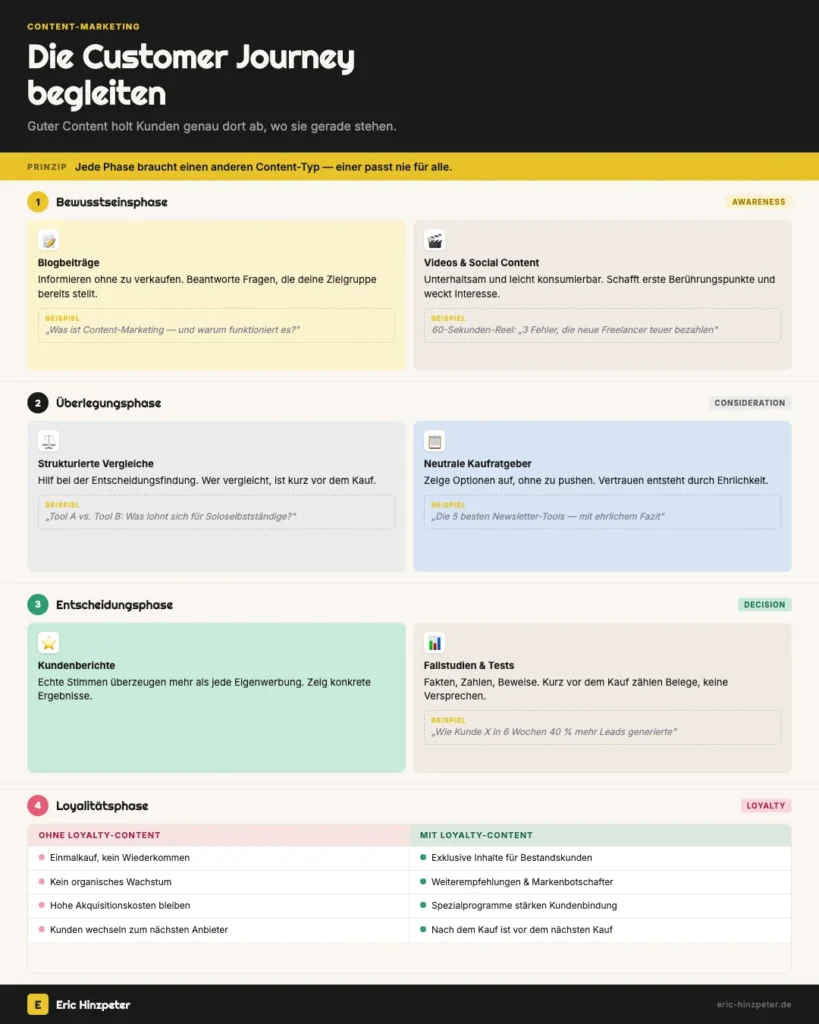
Awareness phase
People don't know your offer yet. Informative blog posts or entertaining videos create first touchpoints and spark interest.
Consideration phase
The interest is there. Now you help prospects along with structured comparisons or neutral buying guides.
Decision phase
Right before the purchase, hard facts and trust count. Customer stories, case studies or product tests make the final decision easier, as this look at the customer journey in content marketing also shows.
Loyalty phase
After the purchase is before the next purchase. Exclusive content or a customer program keeps customers on board. At best, they become brand ambassadors.
Metrics that show success
Which metrics matter depends heavily on your goals. A common mistake: trying to optimize every metric at once. Pick a few meaningful indicators per channel.
Website and blog
- Page views
- Time on page
- Bounce rate
- Conversion rate, e.g. newsletter signups
Social media
- Reach (followers, impressions)
- Engagement (likes, comments, shares)
- Click-through rate
- Traffic to the website
Email marketing
- Open rate
- Click rate
- Unsubscribe rate
- Conversion rate, e.g. product sales
YouTube and video
- Views
- Watch time
- Subscriber growth
- Engagement rate
Podcasts
- Downloads and subscriptions
- Average listening time
- Ratings and reviews
- Conversion rate
Webinars
- Number of attendees
- Engagement during the event
- Conversion rate afterwards
- Return rate for future dates
Why a strategy is still essential
A working content strategy takes time and discipline, but content produced without a goal costs more: resources with no result.
The skill lies in finding formats again and again that offer your audience real value and at the same time pay into your business goals. A look at AI in marketing: 7 examples or at my free browser tools shows how execution can be sped up today without the strategy falling by the wayside.
FAQ
- What is strategic content marketing?
- You create relevant content for a clearly defined audience to win attention, build trust and move people to an action that pays off for your business. Unlike classic advertising, it doesn't put your product at the center. It solves a problem for your audience first.
- Does content marketing actually work?
- According to the Content Marketing Institute's 2025 B2B study, 87 percent of the marketers surveyed say it helped them build brand awareness, and 74 percent report more demand and leads. Even so, only just under half of all respondents, 47 percent, have a documented strategy at all.
- What are the four core areas of content marketing?
- Content creation (text, video, podcast, infographic), distribution through the right channels, measuring success with web analytics, and optimization based on the data. In the long run, SEO is the most important lever for organic traffic.

Eric Hinzpeter
Eric Hinzpeter, Senior B2B Content Strategist. He builds AI agents and marketing automation for production use and writes up what comes out of it here.