NOTE· 2024-04-28· 5 min
How Strategic Content Marketing Works
Content marketing without a plan burns time. How a strategic approach builds a channel that reliably attracts customers.
Content marketing only works with a plan. If you just start writing, you burn time and money. A strategic approach builds a channel that reliably attracts customers and creates long-term trust.
The numbers for 2025 and 2026 are clear. Current data from HubSpot and the Content Marketing Institute (CMI) show why there's no way around this discipline:
| Metric | Value (2025/2026) | Source | | --- | --- | --- | | Cost compared to classic advertising | -62% | CMI | | Leads generated compared | 3x more | CMI | | Companies with an active content strategy | 82% | HubSpot | | Content formats with the highest ROI | Short video (60%), blogs (38%) | HubSpot (State of Marketing 2026) |
So the question is no longer whether you need content marketing, but how to apply it well.
What you'll learn in this post
- Well-known success examples for content marketing
- Definition of strategic content marketing
- The 4 core areas of the discipline
- Building your own content strategy
- Supporting the customer journey
- Measuring success with the right KPIs
Success examples: Dr. Oetker and Coca-Cola
Good content marketing existed long before the internet. Dr. Oetker printed simple recipes on its baking powder bags early on. Later came the first Dr. Oetker school cookbook. That wasn't crude advertising. It was real help in customers' daily life.

Old-school content marketing at Dr. Oetker. The first school cookbook was a full success. By E. Henneking, Dr. Oetker Verlag KG, copyrighted free use, Wikipedia
The result: the brand became a fixture in the kitchen. The company still profits from that today.
A more modern example comes from Coca-Cola. In the "Share a Coke" campaign in Australia, customers bought bottles with their own first names and shared them voluntarily on social media. The campaign generated nearly 1 billion impressions.
If you solve your audience's problems or hit them emotionally, you get rewarded with strong reach and engagement.
Definition: what is strategic content marketing?
In strategic content marketing, you create relevant content for a clearly defined audience. Your goal: gain attention, build trust, and ultimately move users to a profitable action.
The biggest difference from classic advertising: you don't put your product in the spotlight. You solve your customers' problems. You go with customer-centered communication, pure product benefits move into the background at first.
The 4 core areas
Content marketing is a demanding craft. Your work splits roughly into four pillars:
- Content creation: You produce text, video, podcasts, or infographics. Quality has to be there and hit your audience exactly.
- Content distribution: A finished post is worthless if no one sees it. You have to actively spread your content via social media or email newsletters.
- Performance measurement: You check via web analytics and platform statistics how often users see your content and how they interact with it.
- Optimization: You adjust your content based on the data. A key lever here is search engine optimization (SEO), to bring in more organic traffic from Google over the long run.
How to build your content strategy
Without a solid foundation, your content fizzles unseen. A good strategy usually follows these steps:
- Define goals: What do you want to achieve? Brand awareness or direct lead generation? Short-term sales aren't always the top priority here (unlike performance marketing).
- Analyze the audience: Who are you doing this for? Which formats do your potential customers prefer?
- Content audit: Review your existing posts. Where are the gaps? (Tip: for a deeper look, listen to the "Content Audit" episode of the Performance Content Podcast.)
- Plan topics: Build an editorial calendar. My advice: don't set frequency too high at the start. Begin moderately and keep a reliable cadence.
- Produce content: Work through your plan. Stay flexible enough to react to current trends.
- Distribution: Adjust your content to each platform's quirks. Best move there yourself to get a feel for the community's tone.
- Performance check: Watch your metrics. Adjust the strategy immediately when certain formats don't work.
Supporting the customer journey
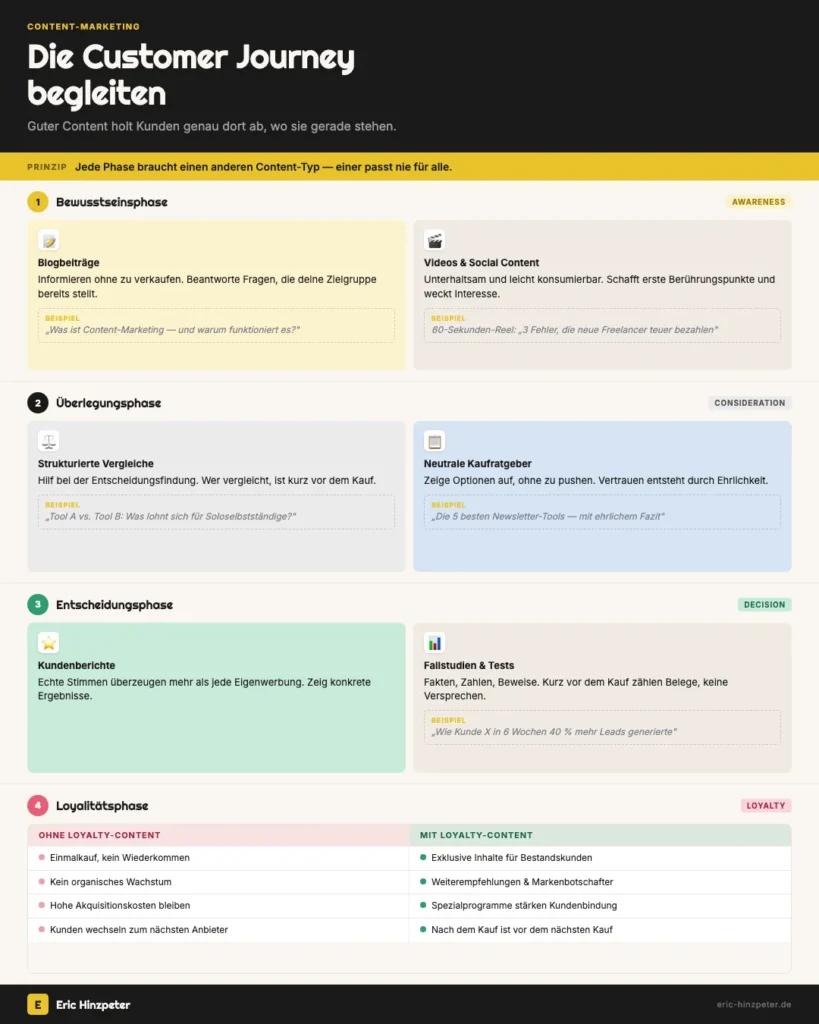
Good content meets potential customers exactly where they are. You accompany them through every phase of their buying decision:
Awareness phase
People don't know your offer yet. You score with informative blog posts or entertaining video. That creates first touchpoints and sparks interest.
Consideration phase
Interest is there. Now you help prospects with structured comparisons or neutral buying guides.
Decision phase
Just before purchase, hard facts and trust count. Customer reports, case studies, or product reviews ease the final decision.
Loyalty phase
After the purchase is before the next one. Hold customers with exclusive content or special programs. At best, you turn them into brand advocates.
Statistics and KPIs
Which metrics to track depends heavily on your goals. A common mistake: trying to optimize every metric at once. Pick a few but meaningful indicators per channel.
Website / blog
- Page views
- Time on page
- Bounce rate
- Conversion rate (e.g., newsletter signups)
Social media
- Reach (followers, impressions)
- Engagement (likes, comments, shares)
- Click-through rates
- Traffic to the website
Email marketing
- Open rate
- Click rate
- Unsubscribe rate
- Conversion rate (e.g., product sales)
YouTube / video
- Views
- Watch time
- Subscriber growth
- Engagement rate
Podcasts
- Downloads / subscriptions
- Average listening time
- Reviews and ratings
- Conversion rates
Webinars
- Number of attendees
- In-event engagement
- Post-event conversion rate
- Repeat rate at future events
Why a strategy is unavoidable
A working content strategy costs time and discipline. Producing content blindly wastes resources. The skill is to keep building formats that offer your users real value and pay directly into your company goals.
FAQ
- What is strategic content marketing?
- Creating relevant content for a clearly defined audience to win attention, build trust, and move people to a profitable action. Unlike classic advertising, it solves the customer's problems instead of spotlighting the product, with product benefits taking a back seat at first.
- Does content marketing actually work?
- The data says yes. Per CMI and HubSpot for 2025/26, it costs about 62% less than classic advertising, generates three times more leads, and 82% of companies run an active content strategy. Short video (60%) and blogs (38%) deliver the highest ROI.
- What are the core areas of content marketing?
- Four: content creation (text, video, podcasts, infographics), distribution (actively spreading it via social and email), performance measurement (analytics on reach and interaction), and optimization (adjusting based on data, with SEO as a key long-term lever for organic traffic).