NOTE· 2026-01-01· 5 min
Prompting Basics: The Guide to Precise AI Results
Why does AI deliver brilliant results for one user and generic junk for the next? Output quality tracks linearly with how much thinking goes into the input.
Honest question: why does AI deliver brilliant insights for one user and generic junk for the next? One thing keeps getting overlooked in the current AI debate: the quality of the output correlates almost linearly with how much thinking you put into the input. That's where the prompting basics separate the pros from the amateurs.
A look under the hood: the AI doesn't understand your thoughts. It processes patterns. Anyone who can't serve those patterns leaves the technology's potential on the table. This guide looks at the architecture behind prompts that actually work, from the anatomy of a command to the hard facts from OpenAI and Anthropic.
Pro tip: documentation instead of improvisation
Stop starting from zero every time. Build a "prompt library". Saving working structures saves serious time and stops quality from being a matter of luck.
What does prompting actually mean?
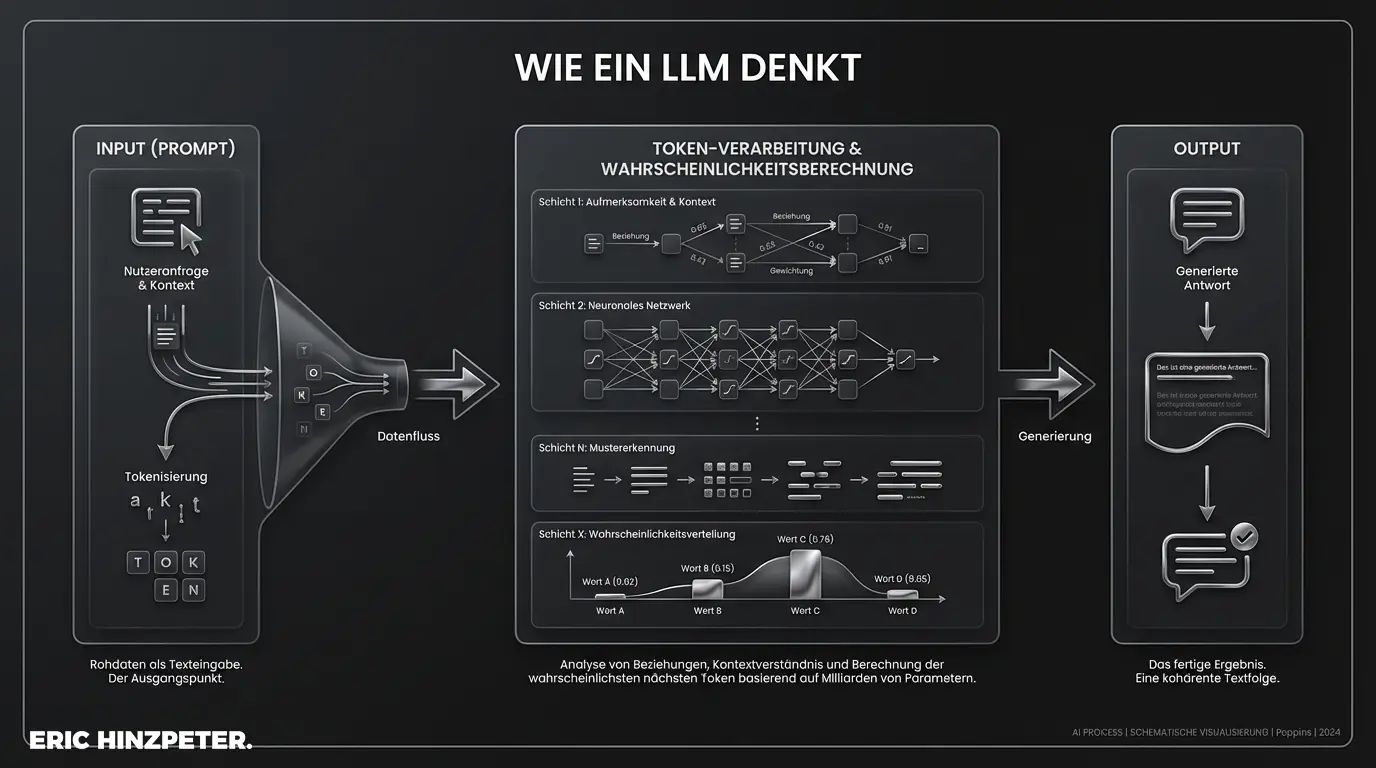
Technically, a prompt is the interface between your intent and the machine's execution. It isn't casual conversation. It's a command set that steers probabilities.
Large language models (LLMs) like GPT-4 or Claude are at heart probabilistic machines. They compute, token by token, what comes next with the highest likelihood. Your prompt sets the guardrails for that computation. The iron IT law applies: "garbage in, garbage out".
Ask imprecisely ("write something about marketing") and you get statistical average. Instruct systematically and you get real expertise. Unlike Google search, where we dig in an index, prompt engineering constructs new content through precise direction.
The anatomy of a perfect prompt
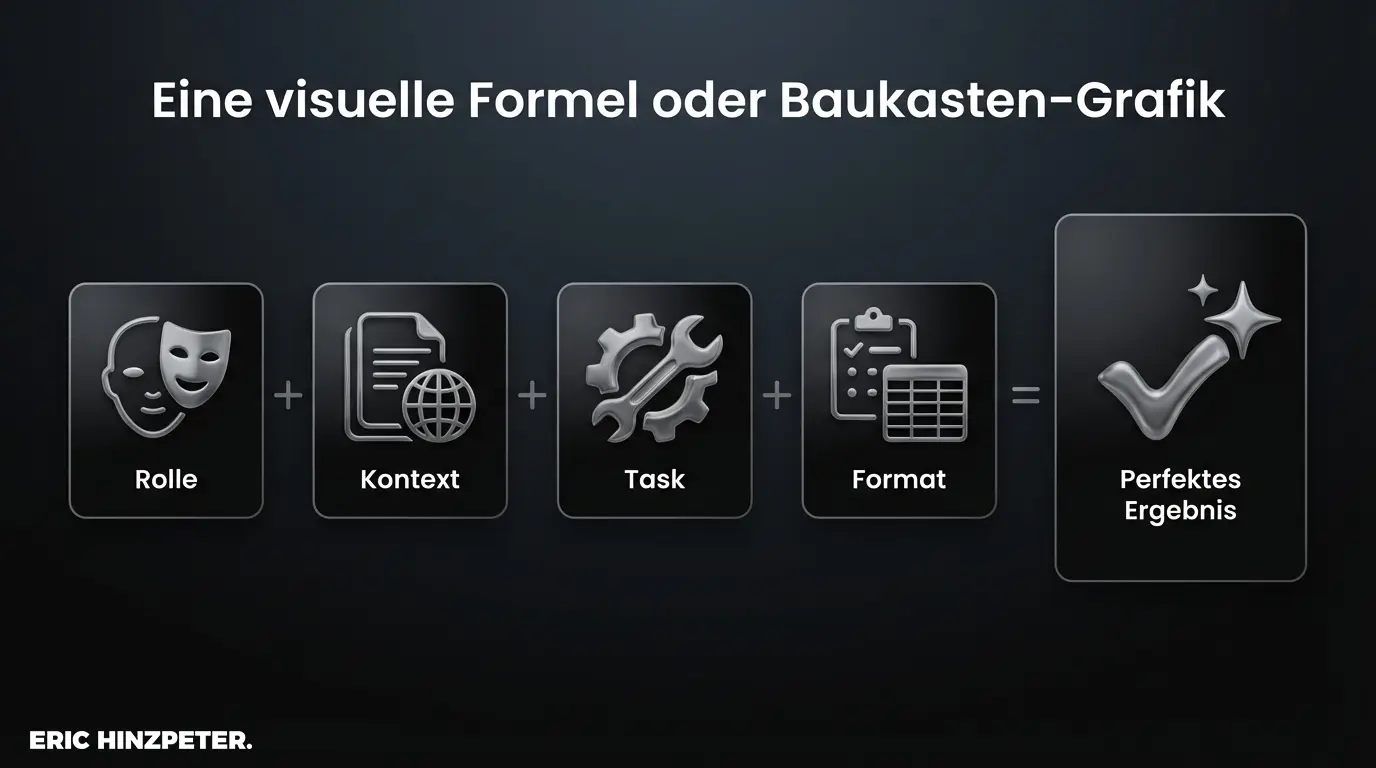
Looking at the documentation from Anthropic or OpenAI, it gets clear quickly: a good prompt is not a one-liner. It looks more like a mini program with four building blocks:
- Role (persona): Who should the AI be? (Simulate the expertise.)
- Context: What does the AI need to know? (Setting and constraints.)
- Task: What exactly should happen? (Use clear verbs.)
- Format: How should the result look? (Structure spec.)
In the content marketing basics we learn how important the audience is. With AI it's the same: missing details kill any result.
Quick check: weak vs. strong
The "naked" prompt (forget it): "Write a text about B2B marketing."
The pro prompt (now we're talking): "Act as a senior marketing strategist (role). We sell SaaS logistics software to CEOs (context). Write a LinkedIn post on the risks of manual supply chains. Open with a provocative thesis (task). Short paragraphs, bullet points, no marketing fluff (format)."
Clear instructions push ChatGPT or Claude out of the default mode.
Why personas aren't a gimmick
"Role prompting" works so well because assigning a persona narrows the AI's search space sharply. The model focuses on a specific area.
Without a persona, the AI uses the average from the entire internet. With a persona, it uses the patterns that fit that role. Use context to set the tone too:
- "Explain it so a 10-year-old gets it."
- "Analyze this soberly and strictly data-backed."
This is the key when you want to create authentic AI content that doesn't sound robotic.
Zero-shot vs. few-shot: the pro strategies
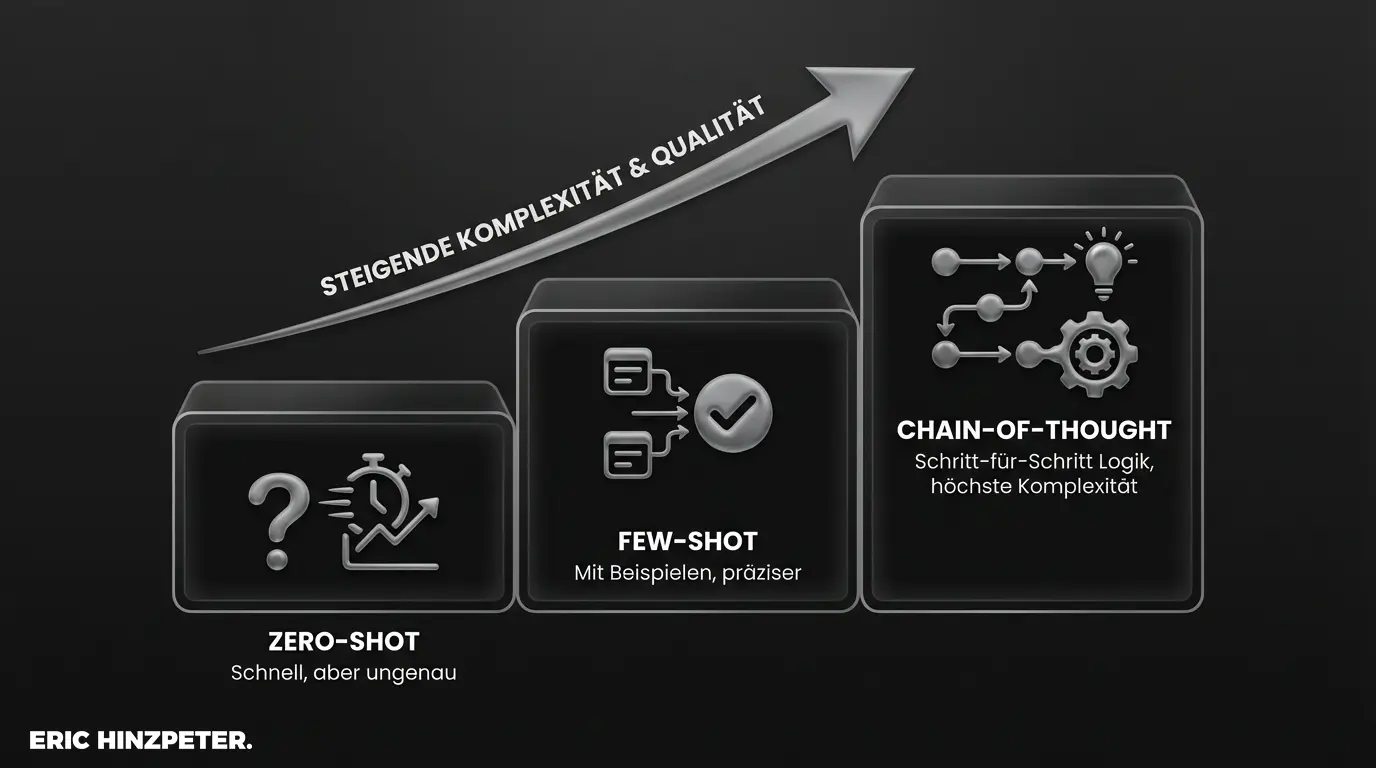
Not every task needs the same effort. There's a clear hierarchy:
1. Zero-shot prompting
You give an instruction without examples. Works for simple knowledge ("when did the Berlin Wall fall?") but often fails on complex formats.
2. Few-shot prompting
You give 1–3 examples of what the result should look like. According to OpenAI, this raises the success rate on hard tasks significantly. You show the AI the template.
3. Chain of thought (CoT)
For logic problems, tell the AI explicitly: "Think step by step". That forces the model to compute intermediate steps instead of jumping (often wrongly) straight to the result.
Pro tip: choose strategically
Use zero-shot for facts. Switch to few-shot immediately if you need a specific writing style or data format (like JSON). Examples are the best insurance against bad results.
Workflow: how to build a prompt
Professional prompting is an iterative process. Pros work like this:
- Draft: Assemble the prompt by the anatomy above.
- Test run: Send it.
- Check: Where does the AI drift? Is the tone too stiff? Anything missing?
- Refine: Add constraints. "Good text, but make it shorter and drop the filler."
A technical hack: use delimiters like ### or --- to separate your instructions clearly from data. Then the AI knows exactly what's command and what's source.
Text vs. image: two worlds
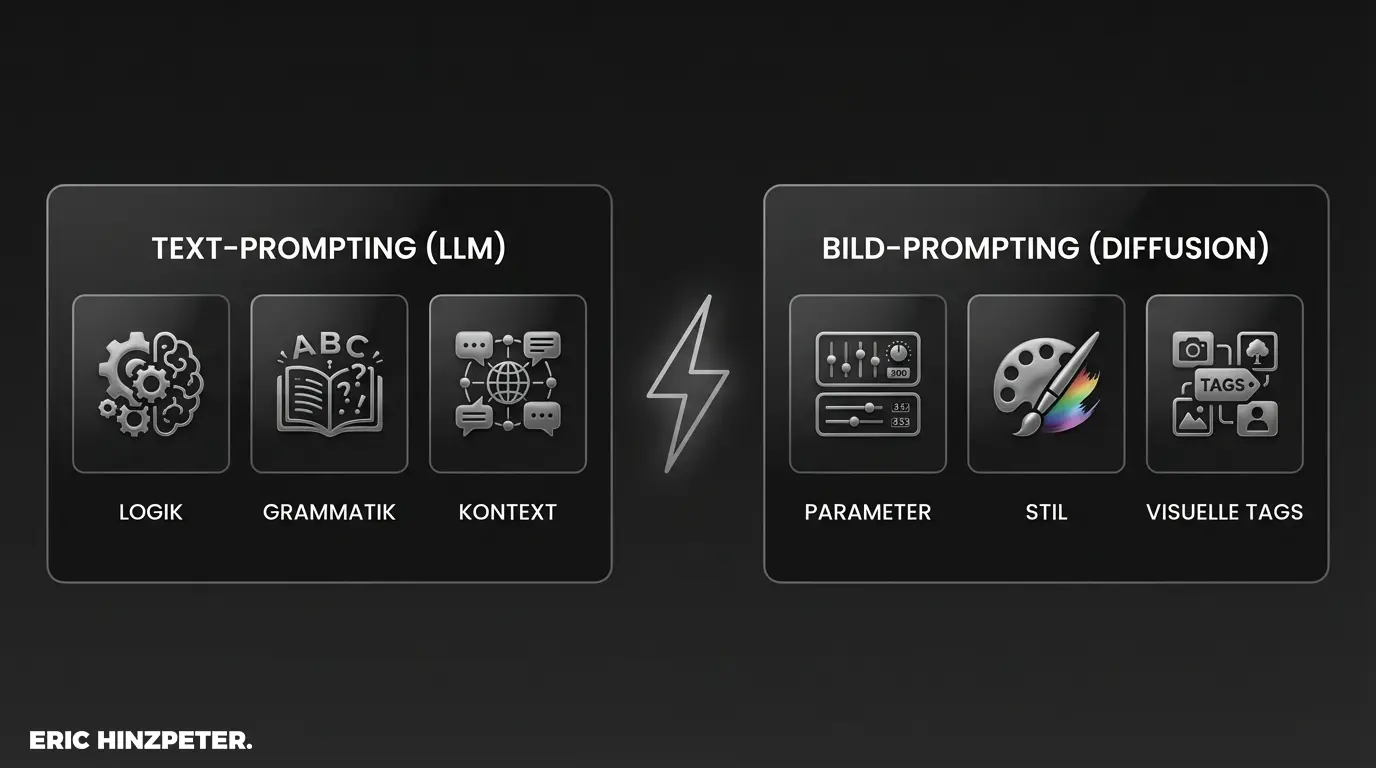
While LLMs go for logic and grammar, image generators like Midjourney speak a different language. Visual associations count more than complex sentences.
With text-to-image, keywords beat sentence structure:
- Parameters: Control commands like
--ar 16:9. - Style references: "Cinematic lighting", "cyberpunk style".
- No politeness: Midjourney ignores "please" and "thank you". Keyword beats grammar here.
Common mistakes (and how to avoid them)
1. Trusting hallucinations blindly
AIs want to deliver an answer, whether it's right or not. When they don't know, they often invent. Fix: allow the AI to say "I don't know" when it finds nothing in context.
2. "Don't write..."
Negative prompts like "don't write boring" are often misread by the AI, which then focuses on the word "boring". Fix: phrase positively. "Write engaging and activating."
Tools for prompt efficiency
The AI tools in content marketing evolve fast. Use resources like the official guides from OpenAI or Anthropic. Those are the sources that really know the architecture.
Bottom line: logic beats magic
Prompting isn't magic. It needs logical thinking and precision. Master the prompting basics and you stop operating a black box and start steering a machine. Theory is nice, but the logic of application is what counts.
FAQ
- What makes a good AI prompt?
- Structure. A strong prompt is built like a mini program with four parts: role (who the AI should be), context (what it needs to know), task (clear verbs for what to do), and format (how the result should look). Vague prompts return statistical averages; specific ones return real expertise.
- What's the difference between zero-shot and few-shot prompting?
- Zero-shot gives an instruction with no examples, fine for simple facts. Few-shot gives 1 to 3 examples of the result you want, which sharply raises success on harder tasks and is the move whenever you need a specific writing style or data format like JSON.
- How do I stop AI from hallucinating in my prompts?
- Explicitly allow the model to say 'I don't know' when it finds nothing in the provided context, since AIs tend to invent answers rather than admit gaps. Also phrase instructions positively ('write engaging') rather than negatively ('don't write boring'), which the model often misreads.