NOTE· 2026-02-03· 6 min
AI in Marketing: 7 Examples and Strategies for 2026
7 concrete use cases that show how AI in marketing today goes beyond text generation, from lead scoring to content architecture.
AI today is your autonomous agent. You set the goal, the system finds the way. The result is measurable efficiency gain, not just nice text.
Key application areas for AI in marketing
AI today touches the whole marketing architecture.
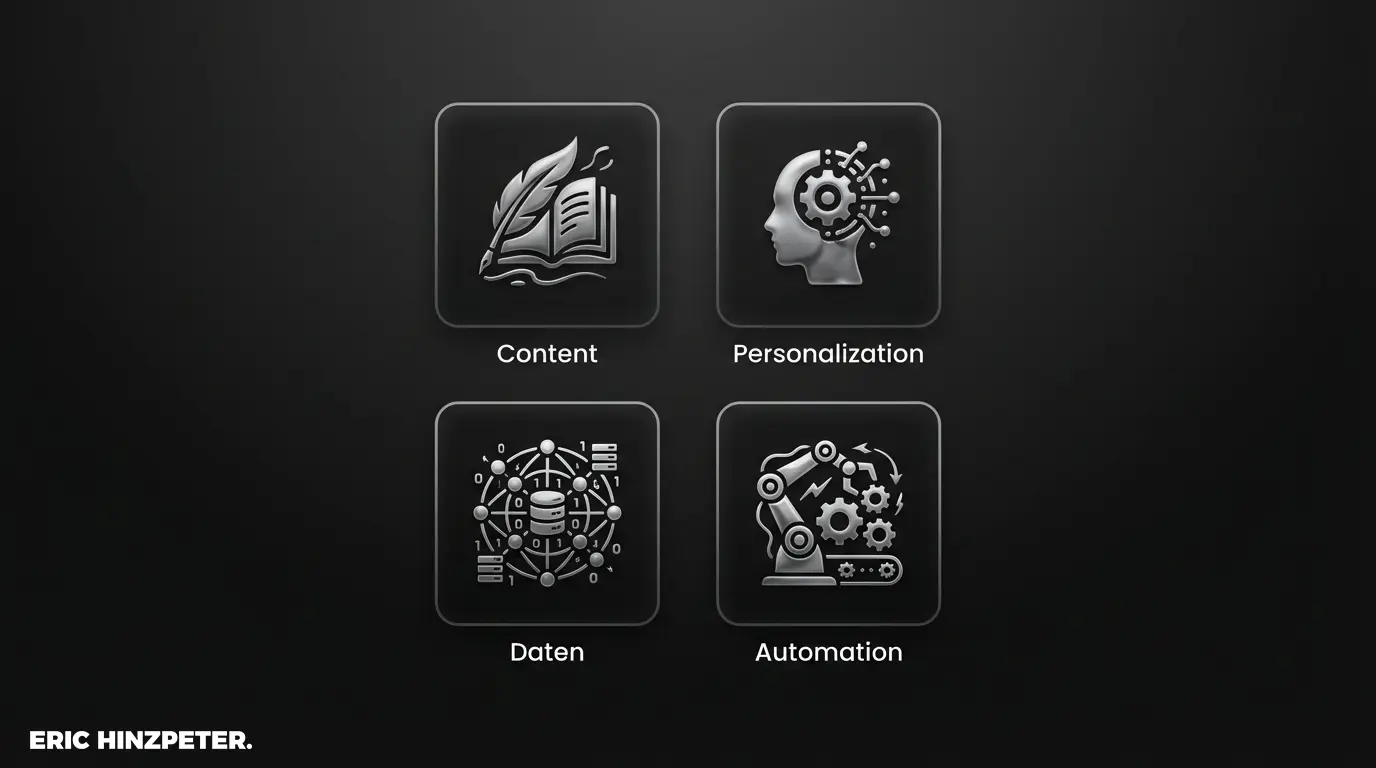
The four pillars you need on the radar:
- Content creation and optimization: Not only text for the blog. We're talking social media marketing assets, videos, code. All scalable. Tools like peec.ai help track your AI visibility, while ahrefs or Sistrix deliver the data base.
- Personalization and customer journey: The "Netflix principle". Your customers expect offers based on their behavior. The customer experience is computed in real time.
- Data analysis and prediction: Knowing what happens before it happens. We use CRM data to look forward (predictive analytics).
- Marketing automation: Processes run through. From email marketing to support or monitoring your SEO and GEO rankings. 24/7.
Automation makes sure recurring processes no longer bind human resources. That creates room for real strategy work.
More on the specific tools sits in my article on the Top 5 AI tools in content marketing.
7 practical examples for AI in marketing (2026 edition)
Theory is grey. Here is how intelligent systems work in practice today, beyond "write me a LinkedIn post".
1. Hyper-personalization (segment of one)
Forget classic audience analysis and personas like "Manfred, 50, likes the newspaper". We work with the segment of one. Personalization is based on real-time data, not assumptions. Amazon and Netflix have shown this for years.
In 2026 this technology is also available for small and mid-sized businesses through modern CRMs. The AI recognizes: the user responds to visual stimuli? Then it shows more images, less text. The prerequisite is a clean data foundation.
2. Autonomous content agents (agentic AI)
This is where the biggest shift is happening right now. You don't chat with the bot anymore. You give the agent a goal: "Build a campaign for product X". The agent researches trends independently, writes drafts, generates images, and brings them to you for approval, often while you sleep. ClawdBot, now OpenClaw, drew attention here, but it brings real security risks.
3. Predictive analytics and churn prevention
Why wait until the customer cancels? Predictive analytics uses historical data to forecast the future. The AI calculates the probability of churn and the customer lifetime value (CLV). When the system spots a top customer at risk, it triggers a retention campaign automatically.
4. Real-time video generation and avatars (sales)
Personalized videos in sales don't scale? They do. Scale used to be expensive. With tools like ElevenLabs (for voice cloning) and Higgsfield AI (for video), teams can send videos in which a photorealistic avatar addresses the customer by name. No cameras needed.
For personal avatars, tools like HeyGen or Synthesia work well.
5. Programmatic advertising and smart bidding
Anyone setting bids manually in performance marketing burns money. AI-driven programmatic advertising decides in milliseconds whether an ad slot is worth its price. The algorithms optimize not for clicks but for conversion probability. Result: less waste, better ROI.
6. AI-driven image editing and design
Need the product against a beach background instead of in the studio? NanoBanana Pro, Midjourney, or the AI built into Photoshop (Firefly) handle that via prompt. Retouching, outpainting, or creating variants for A/B tests happens in seconds.
Automated, this brings a different speed entirely, especially for creative testing.
7. AI-driven customer service (smart chatbots)
The time of dumb chatbots that only run you in circles is over. Modern systems understand context. They don't only send help-page links but access databases, change billing addresses, or cancel orders directly in chat. That takes serious load off support.
The best AI tools for marketers
The market is full of toys. You need tools. To keep an overview in 2026, here's my curated list for a solid architecture:
- The all-rounders (LLMs): ChatGPT (OpenAI), Google Gemini, and Claude. Your base for text and logic.
- Content and presentation: Gamma AI builds complete slide decks in seconds. Higgsfield, Weavy.ai, or Freepik Spaces generate AI videos in seconds.
- Video and voice: ElevenLabs is the standard for synthetic voices. Opus AI for short video content from long video. DaVinci Resolve and Premiere Pro also keep upgrading their AI features.
- SEO and data: Here you still need SEO pro tools. ahrefs and Sistrix for analysis. Tools like SurferSEO for on-page optimization and the still-important content briefings. A tool like peec.ai to make sure your AI visibility strategy works.
How AI changes content creation
Content creation is more than "write a prompt and press enter". The shift is in the workflow. Generative AI takes the grunt work, but the strategy stays with you.
A modern process: tools like ahrefs or Sistrix deliver the keywords. An agent creates the brief. The AI writes the draft. A tool like SurferSEO checks relevance. At the end, a human decides on tone and strategic direction. Prompt engineering and context engineering remain the lever for quality, or you let a specialized agent do that work.
Automation and AI in marketing
One topic we've left aside: automation. I'm in favor of automating only after a proof of concept exists.
Are the processes solid? Scalable? Do they already deliver real value to your audience? Then it's time to think about automation.
For me, there's currently no better tool than n8n. It's user-friendly because it's low-code. It also offers complex customization, so almost nothing is off limits. The learning curve is steep and rewarding.
Challenges and risks in using AI
Anyone using AI has to know the rules. Since August 2026 the EU AI Act applies in full. For marketers it means above all: transparency. AI-generated content that could be mistaken for real often has to be labeled.
On top come risks like data protection and copyright. If you dump customer data into a public LLM, you have a compliance problem. Use enterprise versions that don't use data for training. Ignorance is no business model.
More on the legal framework: the EU's official AI Act page.
Future trends: AI in marketing 2026
Where is this going? We're heading toward machine-to-machine marketing. Your AI sales agent negotiates with your customer's AI buying agent. Human intervention reduces to strategy and ethical control. Google UCP showed this in January; these AI shopping systems will come.
The topic of vibe coding also gets interesting: marketers build their own small apps and workflows by simply describing what they need to the AI, with no programming skills.
FAQ
- How is AI used in marketing in 2026?
- Beyond writing text, AI now runs processes end to end: hyper-personalization, autonomous content agents, predictive analytics for churn, personalized sales video, programmatic ad bidding, AI image editing, and context-aware customer service. Strategy stays with humans while AI handles the repetitive work.
- Is AI-generated marketing content legal in the EU?
- It's allowed, but the EU AI Act applies in full since August 2026 and centers on transparency. AI-generated content that could be mistaken for real often has to be labeled, and customer data should only go into enterprise LLMs that don't train on your inputs.
- What are the best AI tools for marketers?
- Start with the LLM all-rounders (ChatGPT, Gemini, Claude) for text and logic, add Gamma for slide decks, ElevenLabs for voice and HeyGen or Synthesia for avatars, ahrefs or Sistrix for SEO data, and n8n for low-code automation.